
Latest Articles
-
![]()

Applying "The New Classroom Instruction That Works" in the Classroom
by Justin LiendoLearn how the Marzano teaching strategies from The New Classroom Instruction That Works can be applied in real classrooms. Discover practical examples using reusable dry erase flipcharts to support student engagement, retrieval practice, collaboration, and visual learning.
- active learning classroom strategies
- Classroom Engagement
- classroom instruction that works
- classroom instruction that works teaching examples
- cooperative learning strategies
- curriculum
- dry erase
- dryerase
- eco-friendly
- Education Research
- examples of marzano instructional strategies
- formative assessment strategies
- goodwin
- how to use marzano strategies in the classroom
- marzano
- marzano instructional strategies
- marzano strategies classroom
- marzano teaching strategies
- math
- Math Skills
- mathematics
- non-permanent surfaces
- research based teaching strategies
- Retrieval Practice
- retrieval practice classroom
- reusable
- rouleau
- save paper
- student
- student goal setting classroom
- teacher
- teacherblog
- teaching math
- teaching strategies
- the new classroom instruction that works
- thinking classroom
- visual learning strategies for students
- visuallearning
- vnps
- whiteboard
-
![]()

Book Study: Building Thinking Classrooms by Peter Liljedahl
by Andrew JorgensenIn 2003, Jane, a middle school math teacher, struggled with a new problem-solving curriculum, revealing that traditional teaching methods kept students busy but not truly thinking. Over 15 years, working with 400 K-12 teachers, 14 key factors were identified to foster deeper student engagement and thinking. Implementing specific practices such as using vertical non-permanent surfaces (VNPSs), random grouping, and dynamic workspaces led to the development of thinking classrooms where students actively engage in meaningful learning. These innovative methods break institutional norms, creating environments that promote sustained intellectual engagement and collaboration. -
![]()
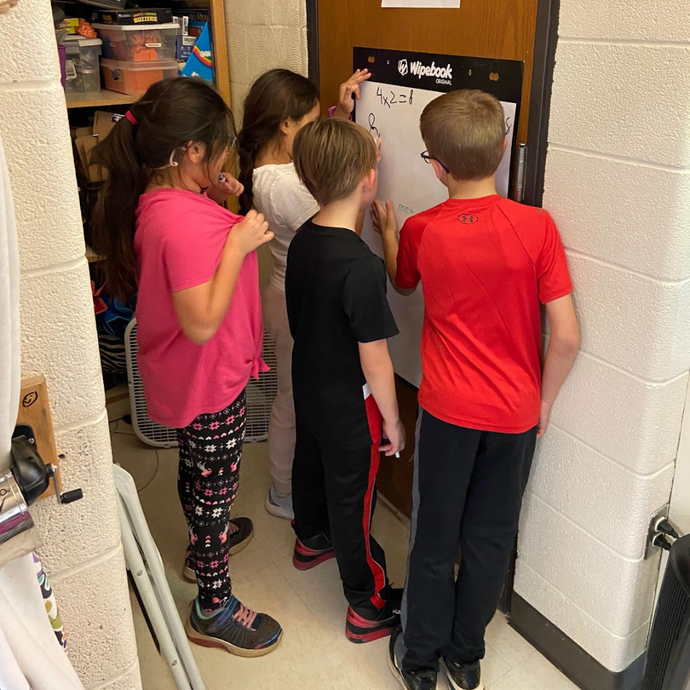
Creating a Thinking Classroom With the Second Grade
by Ana MiglianoThe Wipebooks flipcharts allow students to not only think about and discuss their reflection questions, but also write out some of their ideas. We tend to retain more information when we’ve seen it, discussed it, and written it down than when doing one of those in isolation.


Use left/right arrows to navigate the slideshow or swipe left/right if using a mobile device